Author: admin

INFO : Guide to tenancy agreements in Malaysia

No Comments

THIS is the first of a four-part series article intended as a simple guide to tenancy agreements for landlords who wish to rent out their property in Malaysia.

It covers tenancy agreements in Malaysia, what they are, why you need it as a landlord, the tenancy process, deposit amounts, and sample tenancy agreement as reference.

RENTING OUT PROPERTY IN MALAYSIA

Even though the profit from rental property has dropped over the years (a landed house will fetch 2.5 per cent rental yield today versus five per cent a decade ago), it’s a tried and tested way to generate income while owning an appreciating asset.

However, while many people think that rental income is equivalent to passive income, this is not always true. There are many expenses and much effort needed when it comes to managing a rental property. These include listing costs, property agent fees, as well as upkeep of the property (during and in between tenancies).
There are hidden costs, too, especially if you run into problems with your tenant. If you don’t have a tenancy contract drawn up between you and the tenant, it will be harder to resolve any disputes. A prolonged dispute can quickly cancel out any profits that you have gained from the rental income.

That’s why a clearly-worded tenancy agreement is important to protect both the landlord and the tenant’s welfare.

WHAT IS A TENANCY AGREEMENT?

A tenancy agreement is a legal contract between the landlord and the tenant. It covers the responsibilities of both sides for the duration of the tenancy.

To make the tenant agreement as complete as possible, a landlord can hire a lawyer to draft it out. And the tenant can engage their own lawyer to review the agreement and make any changes before signing.

But hiring a lawyer to draft a tenancy agreement can be expensive. So, many people choose to draft their own agreement and ask the other party to agree to it.

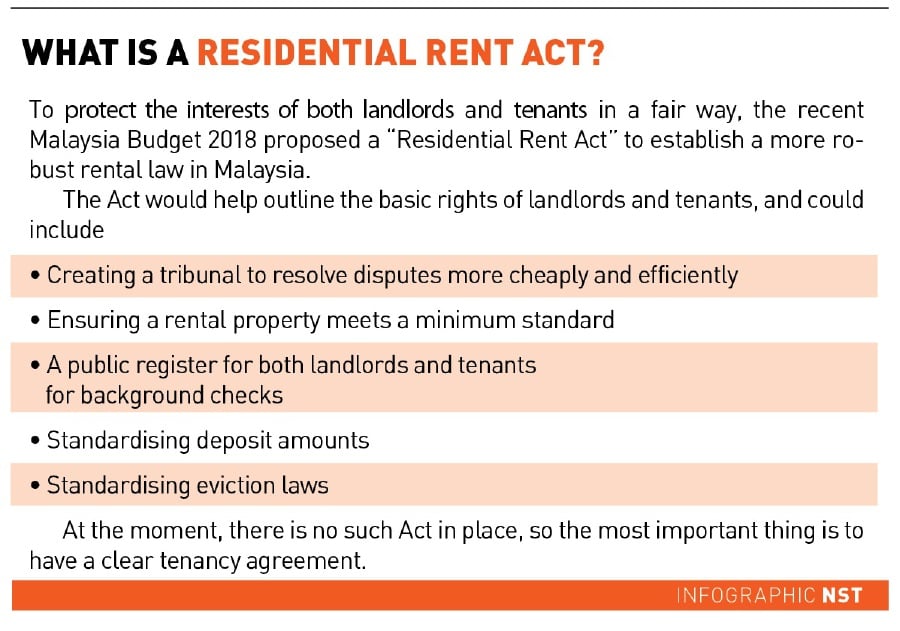
A word of caution about tenancy contracts in Malaysia: there are no government regulations about what can and cannot be added. If either party is not careful, one side can add lots of unfair clauses in their own favour.

Until the Residential Rent Act comes into effect, the tenancy agreement is the only document that protects the rights of the landlord and the tenants.

Property expert Mark Chua prefers to think of tenancies as business arrangements. As he puts it: “(He) is not my tenant. I am not his landlord. We are equal business partners aiming for a win-win relationship.”

WHAT SHOULD BE INCLUDED IN A TENANCY AGREEMENT

There are many details to cover. And the details have to be worded carefully so that there is minimal room for misunderstanding.At its basic level, a tenancy agreement should cover these items:

• The details of the property being rented (type of house, address).

• The purposes of rental (in this case, residential).

• The duration of the tenancy.

• The rental amount.

• The deposit amounts.

• How and when the monthly rental will be paid.

• What will be provided by the landlord as part of the tenancy (such as furniture, utilities).

• The obligations of the landlord throughout the tenancy.

• The obligations of the tenant throughout the tenancy.

• What happens in case of disputes.

• Renewal clauses.

WHEN IS TENANCY AGREEMENT SIGNED?

The landlord and tenant will sign the tenancy agreement when the security deposit is paid. Here is the typical sequence:

1. After you have renovated your property (and optionally furnished it), you can put it on the rental market, or engage a property agent to help you.

2. Your rental property can also be added to many rental listing websites in Malaysia, including iProperty, PropertyGuru, Wonderlist, and Speedrent.
3. After the potential tenant has viewed the property and is agreeable to the terms of rental, they will give you a letter of offer, together with an earnest deposit.

4. Within seven days, the tenancy agreement needs to be signed by both parties. The tenant will also pay a security deposit and utility deposit.

5. Finally, the signed tenancy agreement is stamped and becomes an official legal document.

DEPOSITS NEEDED IN RENTAL AGREEMENT

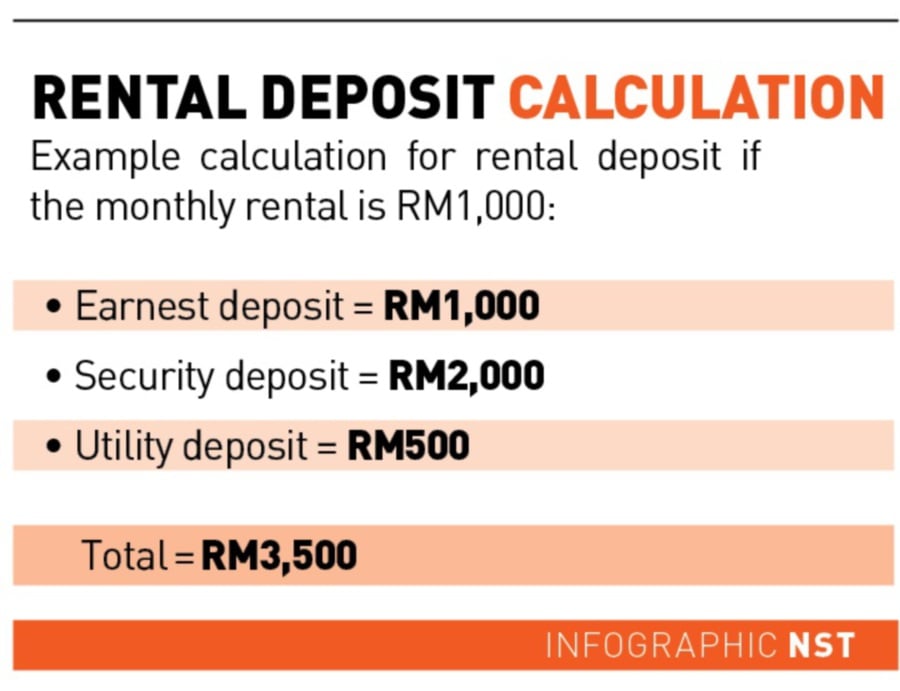
There are three deposits in total:

• Earnest deposit: It is basically a booking deposit, or a deposit to “reserve” the property so that the landlord will not rent the property to anyone else for the next seven days. The amount is equivalent to the first month’s rent. It can be kept in escrow by the property agent. When the tenancy starts, the earnest deposit is usually considered the first month’s rent. Or, it can be used as the security deposit, or it can even be returned to the tenant.

The earnest deposit is also accompanied by a signed “letter of offer” from the tenant. This is a simple one-page document that signifies the tenant’s intent to rent the property.

• Security deposit:This is collected to protect the landlord in case the tenants violate the terms of the tenancy. The amount is usually equivalent to two month’s rent. It can be used to pay for damages, cleaning, keycard replacements, or even be forfeited entirely if the tenant leaves before the tenancy has ended. But if there are no problems by the end of the tenancy, the full amount is returned to the tenant.

• Utility deposit: This is paid to cover any outstanding utility bills at the end of the tenancy, such as gas, electricity and water. The amount is usually equivalent to half a month’s rent.

The security deposit and utility deposit is paid at the same time as the signing of the tenancy agreement.

This article first appeared on Recommend.my. It is written for informational purposes only and does not constitute legal advice from Recommend.my. You should always look for professional help before entering into a legally binding agreement.

CREDIT : NST PROPERTY


INFO : 6 Perks The Rakyat Can Benefit From 0% GST

No Comments

After nearly 3 years living with the system, 6% Goods and Services Tax (GST) is now out of the picture. It was made possible after the major victory that Pakatan Harapan has achieved in the recent General Election.

This move by the government is expected to lessen our (the rakyat) burden. On top of that, it’s supposed to give us better purchasing power and promote economic growth. To date, we have seen some changes in terms of everyday expenditure. In case you’re still lost, here are some of the perks that YOU can leverage from the zero-rated GST.

#1 A Golden Opportunity To Buy A Car

As part of the government’s move to zero-rate the GST, auto companies have revised their vehicles’ prices down. For example, Perodua has reduced the prices of its cars up to RM3,500. Yes, you read that right. Click here to see the newly revised price across the model line-up.

Amongst the companies that have also revised their vehicles’ prices are Volkswagen Passenger Cars Malaysia Sdn Bhd, UMW Toyota Motor Sdn Bhd and BMW Group Malaysia.

Additionally, according to Federation of Motor and Credit Companies Association of Malaysia (FMCCAM) President, Tony Khor Chong Boon, used cars prices are also anticipated to be slightly reduced between 1% and 4% due to this trend.

So do take this chance to get yourself a car before the SST kickstarts in September. In a statement, AmBank Group Chief Economist, Anthony Dass, shared that car prices are expected to increase marginally after SST kicks in. That being said, he also said there are possibilities for auto players to probably absorb the cost (depending on the potential demand).


#2 Start Hunting For Your Dream Home

With GST out of the way, property experts/consultants have shared that this act would encourage the property buyers to make a purchase. According to a local daily, FD Iskandar, Real Estate and Housing Developers’ Association (Rehda) President, shared that property prices are expected to drop following the zero-rated GST implementation.

Sharing the same sentiment is Knight Frank Malaysia Managing Director, Sarkunan Subramaniam. He said: “With the announcement of zero-rated GST, property buyers who intend to purchase commercial properties can now make their decisions as the transaction price will now [from June 1] be cheaper, as they do not need to pay the 6% GST. For residential properties, as building and raw materials will not be charged 6% GST, the selling price is expected to reduce.


#3 You’ll Spend Less At The Supermarket

For most shoppers (if not all), 1 June 2018 was the beginning of happy days simply because they get to buy things at 6% less. We’re sure that you’ve witnessed a lot of the “0% GST” labels.

Recently, The Star had made a spot check to some of the stores if the price tag has changed. The local daily reported that a 1.2kg bag of cat food that was priced at RM14.90, became RM14.05, after 0% GST. Besides that, a packet of 3-in-1 coffee sachets, which was initially RM14.31, is now priced at RM13.50. These items were seen at AEON Supermarket.

Image via MalayMail

You can also see goods’ prices comparison from Hargapedia. It has been monitoring the prices of groceries, household, health & beauty products across 6 different retailers – Giant, Tesco, Econsave, Aeon Big, Aeon and 99Speedmart.

Nevertheless, don’t be confused with the already tax-exempted goods i.e. fresh and frozen meat/fish, fresh vegetables, spice and herbs, baby formula and more. Check out the full list from the Federal Gazette here.


#4 Smokers, Your Lungs Would Likely Be Less Intoxicated

OK, this may be bad news for some of us. In order to curb smoking habits amongst our fellow Malaysians, the government has decided to maintain the retail prices of tobacco products including cigarettes. This is also part of the commitment to the World Health Organisation Framework Convention on Tobacco Control.

The Finance Ministry made a statement recently that removing 6% GST should not be an excuse to sell cigarettes cheaper. This is because the product is harmful to your health and lowering the price would be a form of promotion which is conflicting with the Control of Tobacco Product Regulations 2004.

Perhaps we can look at this matter from a different lens. Maybe it’s time to slowly quit the bad habit and lead a healthier lifestyle. Who’s in?


#5 Electronics/ Gadgets Are Cheaper Now

Have you been planning to buy a new smartphone, laptop or any electronic stuff? This is the time. Before this, all the gadgets/electronics’ prices were inclusive of 6% GST. Now, with 0% GST,  you can save up to a maximum of RM60 for a smartphone that is priced below RM1000.

Imagine how much you can save if the product is worth RM3,000. As an example, iPhone prices have been reduced up to RM334 due to the zero-rated GST. That’s a lot! However, do take note that the price might change once the SST is implemented.


#6 Complete Your Bank Transaction Without GST

If you’re the kind of person who frequently makes bank transactions to pay your bills, this must be good news for you. Why? Because you no longer have to pay 6% extra anymore.

FYI, all of the conventional commercial banks in Malaysia will be charging 0% GST for all banking products and services. This has been confirmed by the Association of Banks in Malaysia (ABM). If you need more info or have any banking issues, get in touch with ABM at 1-300-88-9980.
 

Conclusion

There you have it. Of course, there are more things that you can benefit from the 0% GST such as movie and concert tickets, electricity, telco services, insurance and more.  As you can see, most of the everyday products and services have already been reduced.

If you still see the same old price, it could be that the stores are still in the midst of changing their price tags. According to the news, business premises are allowed to take some time to retag their goods with new prices following the requests for a grace period.

Image via Malaysian Digest

Having said that, please be wary and check your receipt again. Many netizens have been complaining on their social media that some businesses hike their prices after GST zerorisation. In case you encounter shops that still charge you 6% GST or exploit the zero-rated GST i.e. price hike, you can file a complaint to KPDNKK through these channels:

– Call 1Malaysia One Call Centre (1MOCC) at +603-80008000

– Call Information and Strategic Operations Movement Centre (PIGOS)  at +603-88826088/6245

– Use this app called Ez ADU

– Send an email to aduan@kpdnkk.gov.my

CREDIT : Loanstreet.com.my

SALE : 2 1/2 storey Taman Bukit Utama, Bkt Antarabangsa Renovated

No Comments


Untuk Dijual :

2 and half Storey intermediate Taman Bukit Utama, Bukit Antarabangsa
-Land area 1400 sqft
-5bilik & 3bilik air
-mezzanine floor dining
-covered porch (2 cars)
-Renovated
–front ground fl and 1st floor(front balcony)
–back ground fl and 1st floor(back balcony)
& fully furnish unit
-leasehold exp 2084
-Bumi unit
-individual title perfected.
-3min ke Masjid Bukit Antarabangsa
-6min ke Giant Bukit Antarabangsa
– 12min ke Sek. Lembah Keramat, Zoo Negara, FINAS & Consist College
– 18min ke KLCC
– Akses mudah ke MRR2, AKLEH, DUKE,EKVE, Jalan Ampang & lain lain
-asking RM650 000

contact

AZMI 017 2020334

FOR SERIOUS BUYER ONLY. Please check eligibility & deposit-ready before view.

https://property.online2ushop.com

RE: E(3)1641/REN19820/AZ334


INFO : 5 Property tax savings you should know

No Comments

1. RPGT (REAL PROPERTY GAINS TAX) – WAIT IT OUT!

By now you should know understand a thing or two about RPGT. If not, do a quick google search, and you will find out more about it. The table above will give you some insights into understanding how much will you be taxed if you dispose your property. A hint, it’s got something to do with timing. Generally, anything after 5 years is tax free for Malaysians with a residential property and 5% tax if you’re a company or a non-citizen.

If you’re a citizen or a PR holder, you’re entitled to a further tax relief of RM10,000 or 10% of the chargable gain whichever is a greater accrue to an individual.

2. PASS GO NOW

Did you know as Malaysians, you’re entitled to waive off RPGT at least once in your life? Be sure that the property is in your name, and not joined with your partner. Otherwise you and your partner would waste it on only one property disposal and not two.

3. FURNISHING / RENOVATION

Furnishing or renovating your home can be considered as part of your cost against RPGT, but you have to make sure that the items in the house goes with the sale (what you’re claiming for). So keep those receipts and invoices from your interior designer and contractors. It will contribute to lowering taxes if you’re thinking of selling your property within the 5-year window.

4. GST: COMMERCIAL VS RESIDENTIAL

Things have been unclear for those holding on to Commercial properties. According to customs, if a person owns more than two commercial properties or land (more than one acre combined) with a market value of more than RM2mil and has an intention to sell, they are considered to be in business. Thus, a 6% GST fee will be implemented and the owner will need to apply for a GST number.

Does this mean that if I have two properties and I’m on the verge to buying the 3rd, but I am selling off one of my earlier properties means that I am free from GST? Maybe, it’s possible after fulfilling certain criteria.

If you own a residential property, you don’t have to pay GST – there’s RPGT for that.

5. KEEP IT WITHIN THE FAMILY

Tax can be avoided if any property transfers that happen between immediate family members / spouses ie. Transfer by way of gift between husband and wife, parent and child, or grandparent and grandchild, provided that the donor is a citizen and the gift is made within five years after the date of acquisition by the donor.

CREDIT : BUMBUNG.CO